Where the Human Stands: Engineering the Boundary Between People and Machines
Every firm now claims a human in the loop, but the phrase has been stretched until it means almost nothing. The real question is architectural, and it has four answers.

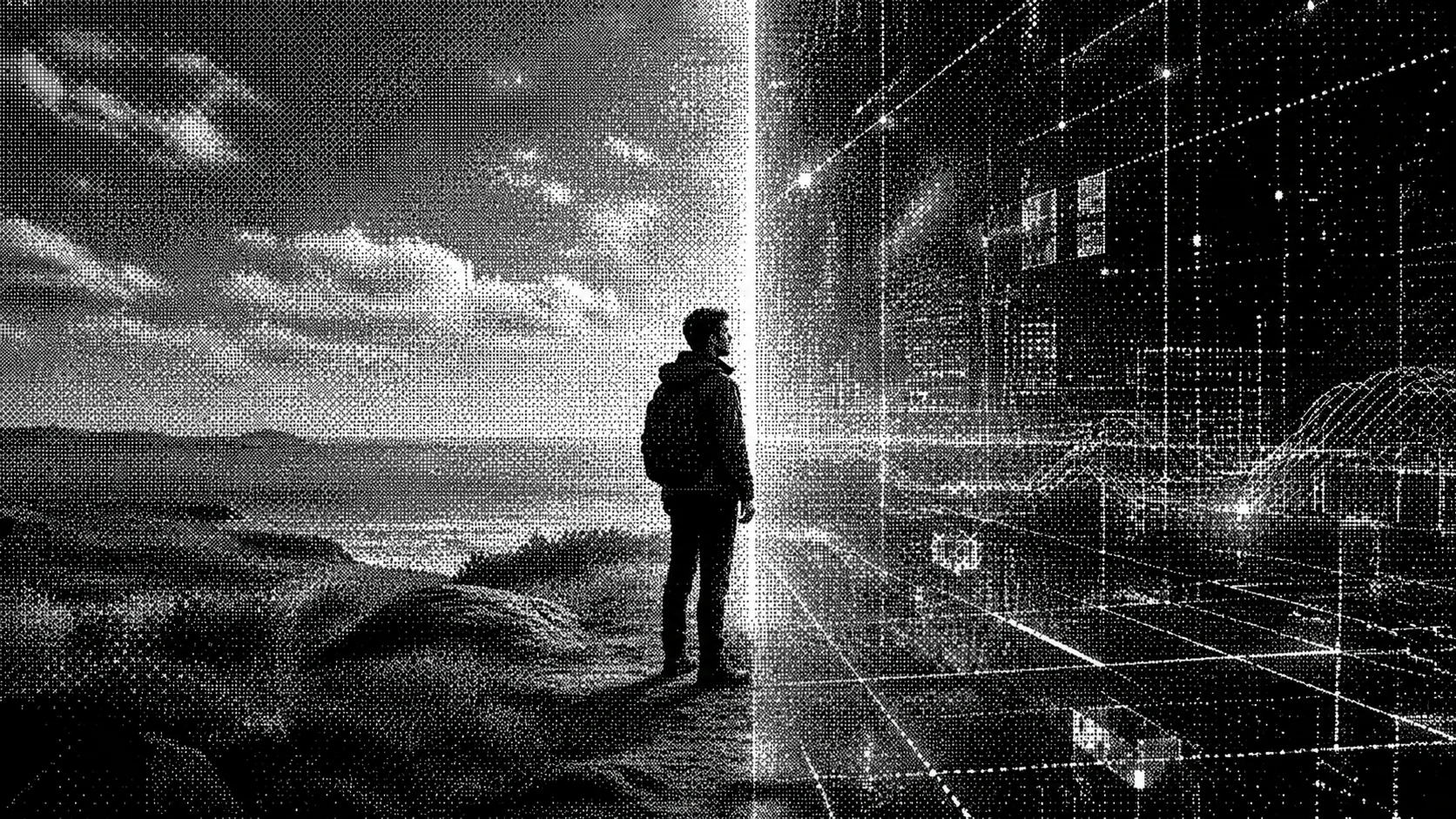
We closed our essay on Moravec's paradox with a claim that was easy to write and hard to honor: that the boundary between human and machine intelligence is the single most important design decision in any system built on both. It is easy to write because it sounds sensible. It is hard to honor because the industry has settled on a comfortable phrase that lets almost anyone claim to have drawn that boundary with care, without ever specifying where it sits, what it is actually able to hold back, or whether it is permitted to move. The phrase is "human in the loop," and what follows is an attempt to take it apart and rebuild it into something an engineer, and a client, can reasonably trust.
The phrase began life in control systems, where it once carried a genuinely precise meaning: a process that could not reach completion without a deliberate human action. A targeting system could track and calculate all it liked, but a person had to authorize the consequence. Over the following decades, as the language migrated out of aerospace and defense into enterprise software and finally into the present wave of artificial intelligence, that precision quietly drained away. Today "human in the loop" functions less as an architectural commitment than as a reassurance offered to a procurement committee, and it has grown compatible with very nearly any design, including designs in which the human's only real contribution is to absorb responsibility for outputs they were never given the time to read. A description broad enough to cover both a physician reviewing every diagnosis and a compliance officer initialing a thousand reports an hour has stopped describing anything at all.
So we set the phrase down and worked instead from the questions underneath it. Where, exactly, does a person stand within a given workflow? What is that person genuinely able to stop? And, the question we found almost no one asking, what does the system learn from the fact that the person acted? Following those questions honestly led us not to a single human-in-the-loop design but to four of them, each occupying a different place along the boundary, each doing work the others cannot, and the last of which we believe most of the industry has yet to build.
Four positions along the boundary
Humans in the loop. In the first and most literal sense, human input is a structural dependency rather than a convenience the system offers when time allows. A number of the processes and analyses that run inside Vantage are deliberately built so that they cannot reach completion without a person contributing something only a person can contribute: a missing piece of context, a judgment on data that is genuinely ambiguous, a decision about the intent or scope of the work itself. Where that contribution is absent, the workflow does not quietly find a way around it, and it does not generate a confident guess in order to keep moving. It stops, and it asks. The discipline this requires is a subtractive one, and it is the more difficult discipline, because the natural impulse of any capable system is to finish what it started. A process that can complete without you was never one you were inside. It was one you happened to be standing near.
Humans at the gate. The second position sits at the end of the pipeline rather than within it. Before any completed analysis leaves Vantage, before it reaches a client, an investment committee, or a limited partner, a qualified person reviews the work and puts their name to it. This is where accountability actually resides, and it has to be a human position because accountability is not a property that machine work can earn on the strength of its own qualities. An analysis assembled by our agents may be more thorough, better sourced, and far faster than anything an unaided person could produce, and not one of those merits makes it something a firm can stand behind. Standing behind work is itself a human act. It requires someone who has read the analysis, judged it sound, and accepted the consequences of being wrong about that judgment. A signature at the gate is the record of that act, and nothing reaches a client without one.
Humans providing feedback to the machines. The third position follows directly from a decision we made early and have written about since: our agents are designed to disagree with one another rather than to dissolve their differences into a single, smoothed-over answer. The disagreement is the value, because it exposes precisely the questions a firm ought to be weighing, but a disagreement left to stand is only half of a functioning system. The other half is the expert who resolves it. When two specialist agents arrive at opposing conclusions, a person with real domain judgment adjudicates between them, and that adjudication accomplishes two things simultaneously. It resolves the immediate question for the team, and it instructs: the agents revise their approach in light of the ruling, or they locate and request the specific information whose absence produced the divergence to begin with. Handled this way, a disagreement is not a flaw in the output to be tidied away. It is the system identifying, with unusual precision, the point at which human expertise is most needed, and turning each application of that expertise into something the machines retain.
Humans training the machines to stand at the gate. The fourth position is the one we regard as most important and encounter least often, because it treats the review performed at the second position not as unavoidable overhead but as the most valuable training data a firm possesses. Every correction a reviewer makes at the gate, each edit, refinement, and quality-control judgment, records something specific about the distance between what an agent produced and what the firm was ultimately willing to publish. Accumulated over time, those corrections compose an increasingly exact portrait of what excellence looks like in a given category of analysis, and that portrait is the material from which an agent capable of holding the gate itself is eventually constructed. We are deliberate about the timeline, by which we mean we decline to commit to one. An agent earns that responsibility not on a date fixed in advance, and not because a demonstration happened to go well, but only once its work has reached a level of excellence that is at once predictable and measurable against the very people who taught it. Until that threshold is met, the humans hold the gate, and their reviews continue quietly making the machine better at a job it has not yet earned the right to perform.
How boundaries fail
It is worth treating the alternatives fairly, because each of the common failures is an overcorrection in the direction of a real and defensible value, and grasping the value is the only reliable way to understand why the failure is so easy to walk into. The difficulty in every instance lies not in the instinct behind the design but in the fact that the boundary was drawn once, at a single moment, and thereafter treated as settled rather than as something requiring continuous maintenance.
| Boundary design | How it works | Where it breaks |
|---|---|---|
| No human present | The pipeline runs from end to end and delivers its result directly to the recipient, on the premise that the model is now good enough to be trusted without supervision | Errors accumulate with no one positioned to intercept them, and the first party to discover a mistake is the client, which is at once the most damaging place for it to appear and the most costly to correct |
| The rubber stamp | A person is nominally required to approve the output, but the volume they are asked to approve far exceeds anything a person could meaningfully examine | The firm holds accountability on paper and none in practice. The reviewer inherits liability for work they never had the standing or the time to shape |
| The frozen boundary | Humans review everything, indefinitely, with no mechanism through which the machine grows more capable as a result of being reviewed | Expert time is consumed entirely by quality control, review hardens into the constraint on the whole firm, and the defining opportunity of the era, a boundary that learns, is quietly surrendered |
The third of these warrants particular attention, because it is the respectable failure, the one that careful and genuinely well-intentioned firms are the most likely to mistake for prudence. Reviewing everything, forever, feels responsible, and it remains defensible right up until the moment the review queue itself becomes the factor governing how much the firm is able to accomplish. Caution that is never converted into capability is not a virtue that happens to carry a high price. It is a cost that has been quietly mistaken for a virtue.
A boundary maintained, not merely drawn
What binds the four positions together, and what distinguishes this from an ordinary org chart with an AI layer fastened underneath it, is that the fourth position lends the whole arrangement the ability to change in a disciplined and legible way. The mechanism is not especially mysterious. Each time a reviewer revises an agent's work before releasing it, the difference between the draft and the published version is captured, and that difference is an honest, quantitative measure of the gap between what the machine can presently do and what the firm actually demands. As an agent improves, the gap narrows; and when it narrows to the point of effectively closing, and remains closed across a meaningful run of cases rather than a fortunate handful, confidence stops being a matter of impression and becomes a matter of record.
Only at that point does an agent advance to the gate, and even then the person does not depart the system. The person ascends within it, moving from the review of each individual output to the auditing of the agent that now reviews them, from the practice of quality control to the governance of how quality control is practiced. This is the feature of the design most easily overlooked and most essential to it: the boundary moves, and yet it never dissolves. Judgment and final authority remain permanently on the human side, not as a provisional arrangement to be reconsidered once the technology has matured, but because their placement was never truly a statement about the current capabilities of machines. It was always a statement about the nature of accountability, which cannot be delegated to a system incapable of answering for itself.
The boundary between human and machine is not a line you draw once and then defend. It is an instrument you keep calibrated.
This is what the Moravec allocation becomes when it is practiced as engineering rather than admired as philosophy. The paradox tells us where each form of intelligence holds its advantage, and the terrain map it yields is accurate, but it is also a map of the present, and the terrain does not hold still. The four positions are the means by which a working system stays faithful to that map even as the ground shifts beneath it, relocating the boundary deliberately and on the strength of evidence, at the speed at which excellence is genuinely demonstrated rather than the speed at which a roadmap would prefer to promise it.
What the client experiences
For the firms we work with, the machinery underneath resolves into something considerably simpler than its construction. Work arrives faster than a purely human team could produce it, the monitoring of sources and signals never sleeps, and nothing is ever delivered without an owner. Every analysis that reaches a client was either completed with a person's judgment built into it, examined and signed by a person before it went out, or produced by an agent that earned its post under the supervision of the very people whose standards it was trained to satisfy. The constant beneath all three is that behind any piece of work there stands a specific person prepared to account for it, and that remains true regardless of how much of the underlying labor the machines have come to carry.
A decade from now, the boundary inside every serious firm will sit somewhere other than where it sits today, and in most cases the machines will hold ground they do not currently hold. We take that to be the system working precisely as intended rather than a danger to be contained, because the design was never an assertion about where the boundary belongs for all time. It was an assertion about who holds the authority to decide where it belongs, on what evidence, and with responsibility for having decided. That authority is human, and the accountability that accompanies it is human, and in our view that is what it means to build seriously upon machines rather than to surrender the work to them and hope for the best.
Vantage engineers the boundary between your team and ours, and keeps it calibrated as the terrain moves: humans in the loop, humans at the gate, and machines that earn their place under the people who trained them.
Conviction Made Citable.