Show Your Work: What is Takes to Trust a Machine
A partner is about to lean on an AI-drafted memo to help decide whether to put millions into a company. Everything about that moment turns on a question the industry has trained us not to ask: how did the machine get here? This essay is about the machinery we built so that question always has an answer.

It is the night before the investment committee meets, and a partner is reading a memo the platform drafted. The memo is fluent. It has sections and figures and a recommendation, and it holds a view with the even confidence of something that has never doubted itself. The decision it informs is whether to put millions of dollars into one company. And the honest first question in that room is not whether the memo is right. It is: what did this thing actually do?
The fear that AI does not show its work is the defining trust problem of this generation of software, and the fear is rightly placed. Consider everything a person cannot see when a model answers. You cannot see what it read: whether it opened the original document or a summary generated months ago, whether the source it needed failed to load and it proceeded anyway. You cannot see what it forgot: long conversations are silently compacted, earlier material compressed or dropped to make room, so the model may be reasoning over a summary of a summary of the thing you told it an hour ago. You cannot see what it spent: a deep run that consumed enormous effort across forty documents and a shallow one that skimmed two arrive at the same speed, in the same font, with the same confidence. The interface delivers the conclusion and amputates the epistemics.
Everyone who works with these systems knows how dangerous it is to assume and assimilate: to take the fluent answer, fold it into a decision, and move on. The industry's default response to that danger is to ask for trust. Ours is to show the work, and by that we do not mean a performance of diligence. We mean instrumentation. This essay is about what showing the work means when it is engineered rather than staged.
What the spinner hides
The standard experience of heavy AI work is a spinner followed by an essay. Between the two sits everything that determines whether the essay deserves belief: which of the firm's own records were pulled and which were missing, which specialist analyses actually ran and what each concluded, which external sources were reached and which failed, where the reasoning is grounded in evidence and where it is extrapolating. The spinner hides all of it, uniformly, and then the prose arrives wearing the same confidence everywhere, over its strongest claims and its thinnest.
To a serious investor, that artifact is unusable. A memo that appears fully formed after a wait cannot be interrogated: there is no way to tell what it read, what it reasoned over, or where it is guessing, and an argument that cannot be interrogated cannot be staked. This is not a cosmetic complaint about user experience. It is the difference between a document that participates in a decision and a document that decorates one.
Judgment you cannot inspect is judgment you will not stake a decision on.
The trace, and what makes it honest
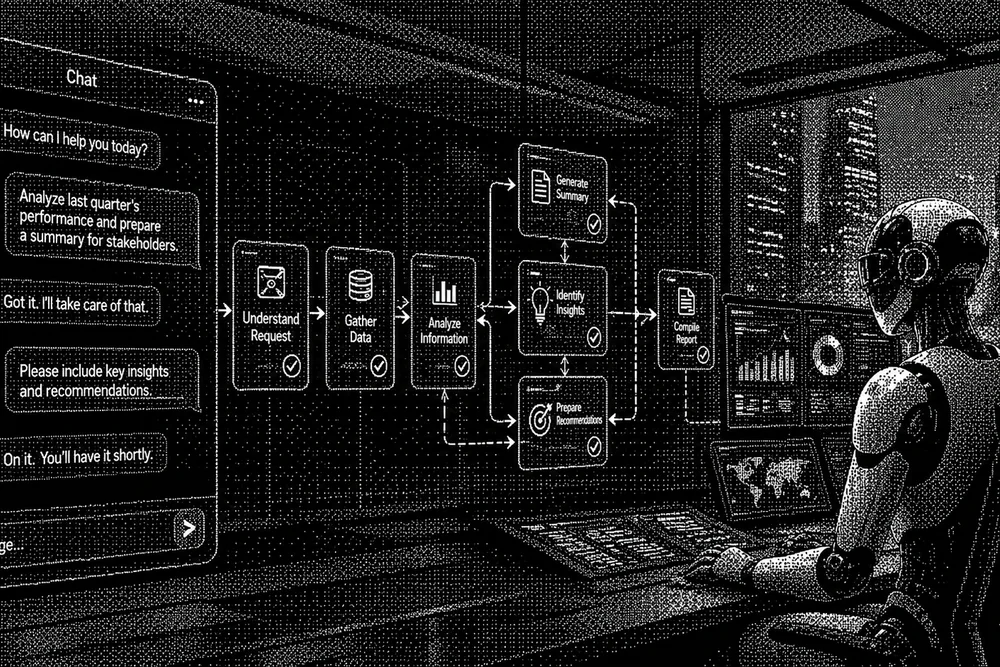
When the platform drafts an investment committee memo, the run opens as a visible spine of phases, displayed in full before any work begins: gathering the firm's own reads on the company, reaching a preliminary recommendation, researching and drafting the memo, auditing the draft. Nothing pops into existence midway. The whole plan is on the table from the first second, each phase waiting its turn, and the spine itself is the progress indicator.
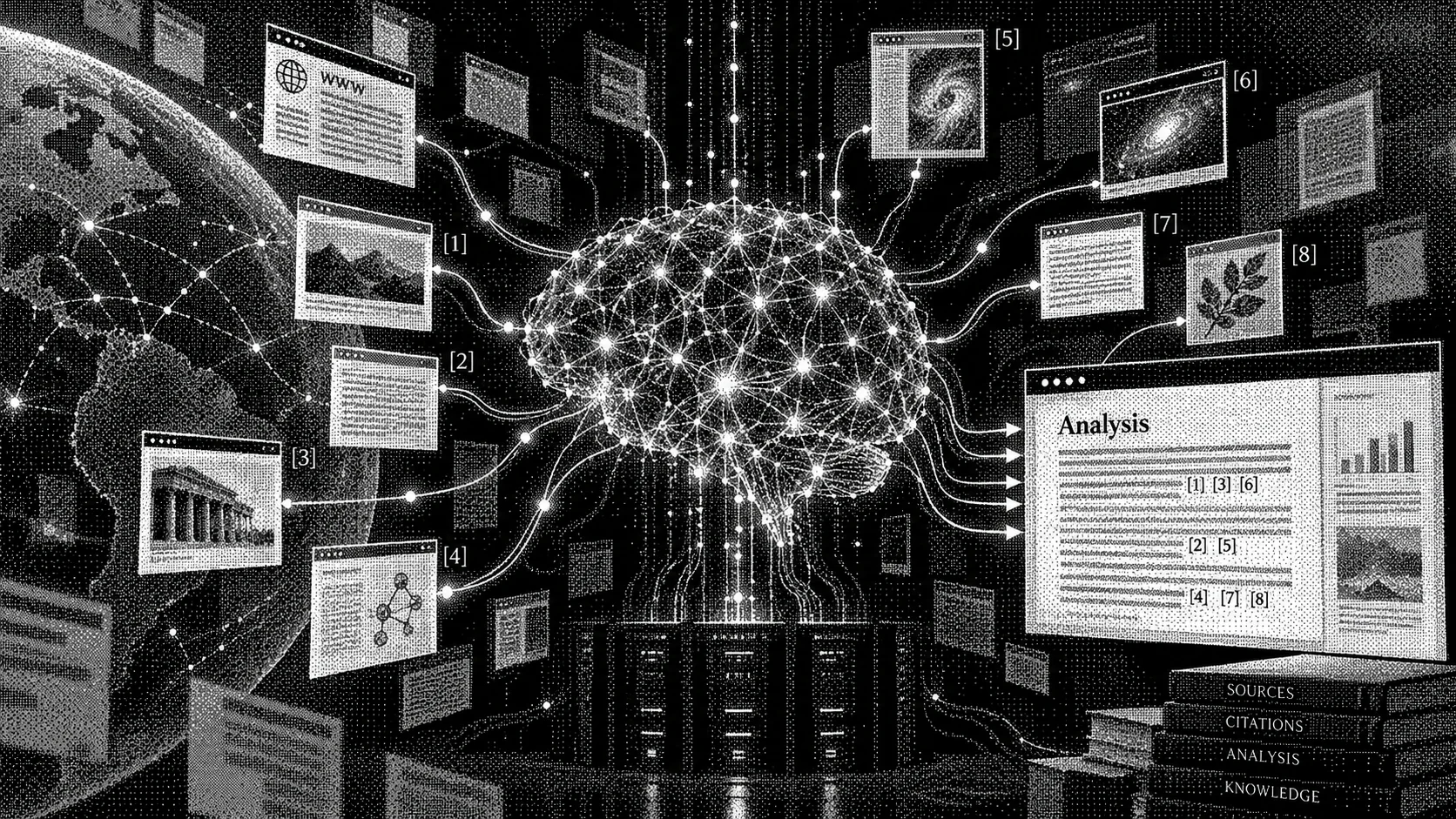
Inside the active phase, two things populate in real time. The first is the roster of specialists actually weighing in, by name: the thesis checker, the financial model, the intellectual property and moat analyst, the governance read. The second is a ledger of sources with running counts: the firm's documents, the news record, the live web, each count ticking up as reads actually complete. Where a total cannot be known in advance, the ledger says so and settles to the truth when the work is done: four pages, it turns out, not a percentage of an unknowable whole.
The governing rule underneath all of it, the one most of the engineering exists to enforce, is that every node on the screen is driven by real work: a real phase transition, a real specialist read, a real tool call. Nothing is a scripted sequence. The counting rules are where that discipline is most visible. A source appears on the ledger only when a real call starts. Only successful reads are counted; a failed fetch advances nothing. And when the system encounters a tool it does not recognize, the event is ignored rather than dressed up as a plausible-sounding source, because a fabricated source on a trust surface would be a small lie in exactly the place lies are most expensive. The rule has a name in the codebase: never invent a source.
The results attached to each finished phase are real values, not theater. The recommendation phase collapses to the actual verdict reached, and if no verdict was reached it says so. The drafting phase collapses to the number of sections actually drafted. The audit collapses to the number of diligence items found and how many still need a human's eyes. A finished trace reads as a record of what happened, because that is the only thing it is capable of displaying.
The gaps are the product
The most valuable thing the trace shows is what did not happen. When the intellectual property analyst finds no assessment on file, the trace does not synthesize a confident-sounding paragraph to fill the hole. It marks the step skipped, with the reason: no IP file on record. When the relationship graph cannot be reached, the trace says the relationship graph was unavailable. The skip is a first-class result, rendered with the same care as a success.
This inverts the failure mode that erodes trust in high-stakes AI. A black box papers over its blind spots with fluent prose, and the reader discovers the blind spot only when the decision built on it goes wrong. A trace that surfaces its skips tells the partner precisely how much of the analysis is grounded and how much is thin, which converts the reader from an audience into an auditor: they know exactly where to push, what to fetch manually, which section deserves the skeptical second read. The gaps are not an embarrassment to be minimized. In a real diligence process, knowing what was not examined is diligence.
A trace that ever embellished would be worse than no trace at all.
Readers of this series will recognize the instinct. Our agents operate under a cite-or-silence rule, and the room does not contain this is one of their first-class answers, a verified conclusion rather than an apology. The trace is that same epistemology, promoted from a rule the agents follow to a surface the partner can watch it being followed on.
A wait that looks like work
Heavy generative work takes minutes, and minutes behind a generic spinner read as a hang. Somewhere around the second minute the user begins to doubt the whole system, before a single word of output exists to be judged. So the third job of the trace is to make the wait legible: the spine advancing through real phases, counts ticking as reads complete, an elapsed clock counting up rather than a countdown counting down to a number nobody actually knows.
The time estimate is held to the same standard as everything else on the surface. Before the run starts, the trace shows an honest range, computed from the firm's own recent completed runs of the same shape. The band deliberately spans the median to the slow tail, so a normal-but-slower run does not read as a broken promise, and every completed run writes its true duration back into the record, which means the estimates sharpen with use. What the surface never shows is a percentage bar or a fabricated countdown, because a progress number that is not measuring anything is the spinner's dishonesty wearing better clothes.
The memo remembers its own reasoning
Underneath the live experience sits the longer-horizon problem, which is provenance. When the run finishes, the trace does not evaporate. It is saved with the memo as its methodology record: what was read and how much of it, which specialists weighed in and what each concluded, what was skipped and why, what the recommendation was and how long the whole thing took. Six months after the investment, anyone can reopen the memo and see the evidence and reasoning that stood behind the recommendation on the day it was made.
In a regulated, fiduciary setting, that record is not a nicety. Limited partners ask how decisions were made. Auditors ask what was known and when. A firm that adopted AI by accepting fluent, unaccountable prose into its process has nothing to show either of them but the prose itself. A firm whose every AI-drafted memo carries its own methodology record can answer with a document. It is the difference between a decision you can defend and one you can only assert.
When not to show the work
Honesty about work includes not performing it. The same visual language runs inline in conversation, where it is driven by the tools an agent actually invoked on this specific turn: pulled the company's profile, mapped the co-investors, delegated the deep read. But it appears only when there is genuinely multi-step reasoning to show. A quick answer that took one tool call keeps a thin status line, because wrapping a trivial lookup in the pageantry of a reasoning spine would teach users that the spine is decoration. The surface earns its credibility by appearing exactly when the work justifies it, and the discipline is enforced in code rather than left to taste.
The same rule all the way down
The trace is one expression of a rule that runs through everything we have written in this series. An agent, we argued, is something that can be wrong on the record, and being wrong on the record requires a record. The human stands at the gate, we argued, and a signature is only meaningful if the thing being signed can be inspected. The scores our agents live under are computed from real outcomes because a fabricated green checkmark corrupts everything downstream of it. At the fleet level the same instinct governs how the system attests to its own health: real gate results, honest failure states, nothing marked passing that did not pass. Show your work is that discipline applied at the most consequential moment in the product: the moment an AI hands a human something they have to bet on.
And it is, finally, an argument about where trust in AI will actually come from. Not from bigger models, which will write more fluent prose over the same invisible epistemics. Not from assurances, which are prose about prose. Trust will come from instrumentation: from systems that expose what they read, admit what they missed, measure themselves honestly, and leave a record that outlives the moment. The machine's judgment becomes usable exactly when it becomes inspectable. That is what show your work means here, and it is one more way of saying the thing this firm was built to say.
Vantage is built on the conviction that an AI worth trusting is an AI that can be audited: its reasoning inspectable, its limits honest, its progress legible, and its conclusions permanently accountable.
Conviction Made Citable.