The Fork Was Never the Problem: How SCCR Made Isolation Possible
Every engineer learns to fear forking. We made it the foundation of the platform. The one thing that made forking irresponsible, the cost of maintaining all those separate copies by hand, is the one thing AI just made close to free.

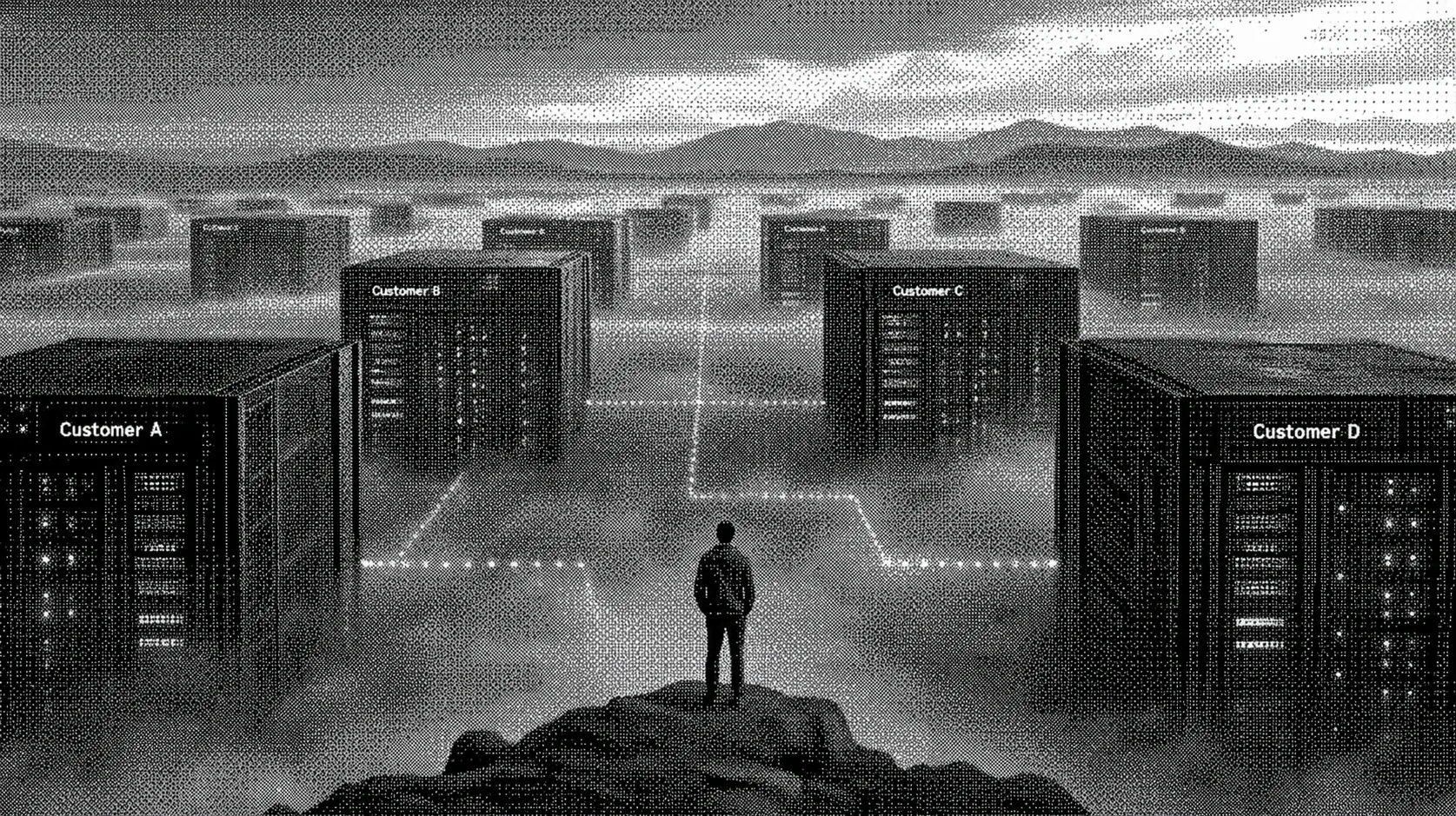
Every engineer learns early that forking is the mistake you spend a career learning to avoid. Copy a shared codebase into a hundred separate versions and you have committed to maintaining a hundred separate versions, each drifting a little further from the others with every week that passes, until a fix that took an hour to write takes a quarter to deliver everywhere it is needed. The entire discipline of modern software is organized around the opposite instinct: one codebase, shared by everyone, changed in a single place. We built Vantage the other way. Every client runs on their own private codebase, forked from ours and maintained on its own, and we regard that as the most defensible architectural decision in the platform rather than the most reckless. What follows is why it is defensible, and why it became possible only in the last two years.
The reason is a shift in economics that most of the industry has not yet priced in. Single-tenant software, in which each client occupies their own isolated instance rather than sharing one with everybody else, was always the better architecture for anyone whose work is confidential and whose needs are particular. It was also, for the better part of thirty years, so expensive to maintain that it was reserved for the largest enterprise contracts and tended to stagnate even inside them. What made it expensive was never the software. It was the human labor of keeping all those separate copies current. Artificial intelligence has collapsed that labor toward zero, and once the cost of maintaining a fork approaches nothing, the fork ceases to be a liability and becomes the product.
The compromise inside every shared platform
Multi-tenancy, the practice of serving every client from one shared codebase, exists for a genuinely good reason, and it deserves to be stated plainly before it is criticized. One codebase is dramatically cheaper to build, run, and update than many, and that saving is real and large. The difficulty is that the client, rather than the vendor, pays for the efficiency, and pays for it in three currencies that rarely appear on an invoice.
The first is a shared blast radius. When every client lives in the same instance, a flawed deployment or a security breach is not one client's problem but everyone's at once, and the individual firm has no way to insulate itself from a failure it did not cause. The second is a ceiling on adaptation. A shared platform can offer configuration, a set of switches the vendor decided in advance to expose, but it cannot easily offer real adaptation, and so the client's workflow slowly bends itself to fit the software instead of the reverse. The third is that the roadmap is never truly yours. Anything specific to how your firm works waits in a queue behind every other client's request, and the queue is owned by the vendor. For most software buyers these costs are tolerable. For institutional capital they are acute, because this is precisely the population that handles the most confidential information, derives its edge from doing things differently, and operates with the most idiosyncratic requirements in the market.
Why no one could simply give you your own copy
If isolation is so clearly preferable for this kind of work, the obvious question is why single-tenant software never became the norm, and the answer is arithmetic. A platform serving a hundred clients as separate forks is a platform maintaining a hundred separate codebases, and every improvement made to the central version has to be reconciled, one at a time, against each fork and the accumulated customizations that make it distinct. The reconciliation is the expensive part. A change that is trivial to make once becomes a hundred careful, error-prone merges, and the total cost scales with the number of clients multiplied by the number of changes, which is a curve that defeats good intentions quickly.
This is not a hypothetical difficulty. It is the problem that some of the most sophisticated engineering organizations in the world have spent decades building elaborate human machinery to manage. The maintainers of the Linux kernel and of Debian developed rigorous patch-series and backporting disciplines precisely to keep divergent versions from becoming unmaintainable, and it still takes armies of people to sustain. Google attempted to tame the fragmentation of Android with a project explicitly designed to separate the core system from the customizations layered on top, and the effort stands as a lasting lesson in how hard the boundary is to hold once it has not been enforced from the beginning. Enterprise single-tenant contracts have long carried seven-figure price tags in part to fund exactly this reconciliation labor, and even then the isolated instances tend to drift out of date and quietly rot. The isolation was always worth wanting. It was the maintenance that no one could afford.
What actually changed
The capability that arrived is the one we described in our essay on Moravec's paradox, applied to our own engineering. Reconciling a change against a divergent codebase is a task that sits squarely in the region where machine intelligence holds a categorical advantage. It requires holding an entire codebase and its full history in working memory at once, running tirelessly on a schedule that never slips, and recognizing with precision how a given change interacts with a given set of customizations. These are not things a team of engineers does somewhat slower than a machine. They are things the machine can do that a team realistically cannot do at all, at least not across a large fleet without a great deal of fatigue and error. The labor that made forking irresponsible has become a scheduled job, and the architecture that was always better has become, for the first time, affordable to run well.
| Architecture | How it works | What it costs the client |
|---|---|---|
| Multi-tenant SaaS | One shared codebase serves every client, updated in a single place | Efficient to run, but every client runs the same compromise. A breach or a bad deployment is universal, and adaptation stops at whatever the vendor chose to expose |
| Single-tenant by hand | Each client is given an isolated instance, reconciled and updated manually | The isolation is real, but maintenance scales brutally with clients and changes, so instances rot and the model is reserved for the richest contracts |
| SCCR (Vantage) | Each client is forked into a private codebase, maintained by a fleet of AI integration agents | The isolation of single-tenant with update velocity closer to multi-tenant. The maintenance cost that made this impossible is absorbed by machines |
We call the model SCCR, for Single Customer Code Repository, and it is the structural core of the platform. It is also the clearest example we can give of a claim we made at launch: that the artificial intelligence is the easy part of building a firm like this, and the hard part is the structure underneath it. The agents are genuinely difficult engineering. The decisions that make the agents safe to run are harder.
How it works
Everything rests on a single foundational discipline, which is a hard and continuously enforced boundary between platform code and client customization. Every part of the system is declared as either core, meaning it belongs to the platform and is shared, or custom, meaning it belongs to one client and to no one else, and an automated check refuses to let the two blur together. That boundary is what makes safe automation possible at all, because an incoming update can be told with certainty which parts of a client's codebase it is permitted to touch and which parts it must never touch. Almost every other decision in the design follows from getting this line right, and the hardest work we have done was drawing it cleanly rather than building anything clever on top of it.
On that foundation runs a small fleet of specialized agents, each with a narrow and well-defined job.
The packager. When we cut a release on the central platform, one agent classifies every change it contains as a security fix, a feature, a repair, or a migration, writes a structured account of what changed and how it should be integrated, and assembles the whole thing into a package. A raw stream of code changes becomes a labeled, versioned release with its intent made explicit.
The integrator. Each client's codebase has its own agent that receives every release and reconciles it against that client's customizations. It compares the release against the client's declared custom surface, predicts precisely where a genuine conflict could arise, applies the large majority of changes that are provably clean without intervention, and escalates only the small remainder that actually collide, each with a proposed resolution for a person to weigh.
The conductor. One agent holds the whole fleet in view, tracking which client is on which version and what is pending, failed, or in need of attention. Its most important function is driving security fixes across every client at once, which is the capability we consider the platform's crown jewel.
The curator. The rarest and most deliberately restrained agent watches for a customization built for one client that turns out to be broadly useful, and drafts a proposal to generalize it back into the platform. This function is heavily biased against acting, because most custom work should remain exactly where it is.
The security path is worth dwelling on, because it is where the architecture earns its keep in the way an institutional client will feel most sharply. Consider a vulnerability disclosed this morning, the kind of finding that starts a clock the moment it becomes known. In a hand-maintained fleet of isolated instances, landing the fix everywhere is a project measured in weeks, and the danger is not only the delay but the possibility that some instance is quietly missed. In our model the fix fans out as a mandatory job to every client codebase at once, the system holds the entire fleet marked unresolved until each client is either patched or flagged, and a human is paged the moment any single client cannot accept the patch. The specific failure the design is built to make impossible is the silently unpatched client. Landing a critical fix across the entire fleet becomes closer to pressing a button than commissioning a quarter of work.
The privacy boundary is part of the architecture
The curator raises a question that matters more to institutional capital than to almost any other kind of client, which is what exactly travels when one firm's good idea is generalized for the platform. The answer is built into the design rather than promised in a contract. What is ever eligible to move upstream is the re-generalized capability, the underlying feature and the points at which it can be extended, and never the client's own instantiation of it. One firm's bespoke logic is structurally incapable of being copied into another firm's codebase, because copying it would be both poor engineering and a breach of confidence, and the architecture treats those as the same prohibited act. For a client whose edge lives precisely in doing things differently from everyone else, this is not a reassurance offered after the fact. It is a property of how the system is built.
The same allocation, all the way down
What ties this back to everything else we have written is that SCCR is our own engineering governed by the same rules we ask our clients to trust. The agents do the categorical heavy lifting, holding an entire fork history in context and reconciling thousands of changes without fatigue, exactly the terrain on which machine intelligence dominates. The humans stand at the gate on the decisions where accountability cannot be delegated. A change classified as a security fix requires mandatory human confirmation before it ships, because a security fix mislabeled as something routine is the worst failure the system can produce, and no automated judgment is permitted to make that call alone. Generalizing one client's work back to the platform is always gated by a person. The machines take coverage, the people keep conviction, and the platform is built the way we tell our clients to build.
The fork was only ever a liability because of what it cost to maintain. Remove the cost and it becomes the most honest thing you can give a client: software that is actually theirs.
For thirty years the received wisdom held that forking was the mistake you never made, and the wisdom was correct, because for thirty years the maintenance was ruinous. The wisdom was a response to a cost, and the cost has now changed. What remains once the cost is gone is the plain fact that isolated, adaptable, current software is better for a firm handling confidential work than a shared compromise ever could be. The codebase a Vantage client runs on is genuinely their own, kept current by machines and answered for by people, and defensible on every axis a serious firm should care about. That is what it looks like to take an old engineering fear and a new engineering capability seriously at the same moment.
Vantage gives every client their own codebase, kept current by an AI agent fleet and answered for by the people who run it.
Conviction Made Citable.