No Standing Keys: Why No One Can Reach Your Data, Not Even Us
Most software asks you to trust that a wall between your data and everyone else's will hold. SCCR removes the wall by removing the shared room. You are the only firm on your codebase, no one holds standing keys to it, not even us, and that guarantee had to be true from the first line of code.


There is a question worth putting to any software vendor that most of them would rather you did not ask, which is who, precisely, can see your data. Not who is permitted to by policy, but who is technically able to reach it. In the ordinary architecture of enterprise software the honest answer runs longer than the marketing implies. Your data occupies a shared instance alongside the data of every other client the vendor serves, and the separation between them is a wall assembled out of permissions code, written and maintained by the vendor. The vendor's own engineers necessarily stand above that wall, because operating a system requires the ability to reach into it. The wall is usually well built and often audited. It remains a wall, and a wall is a structure that can be misconfigured, defeated, or quietly climbed.
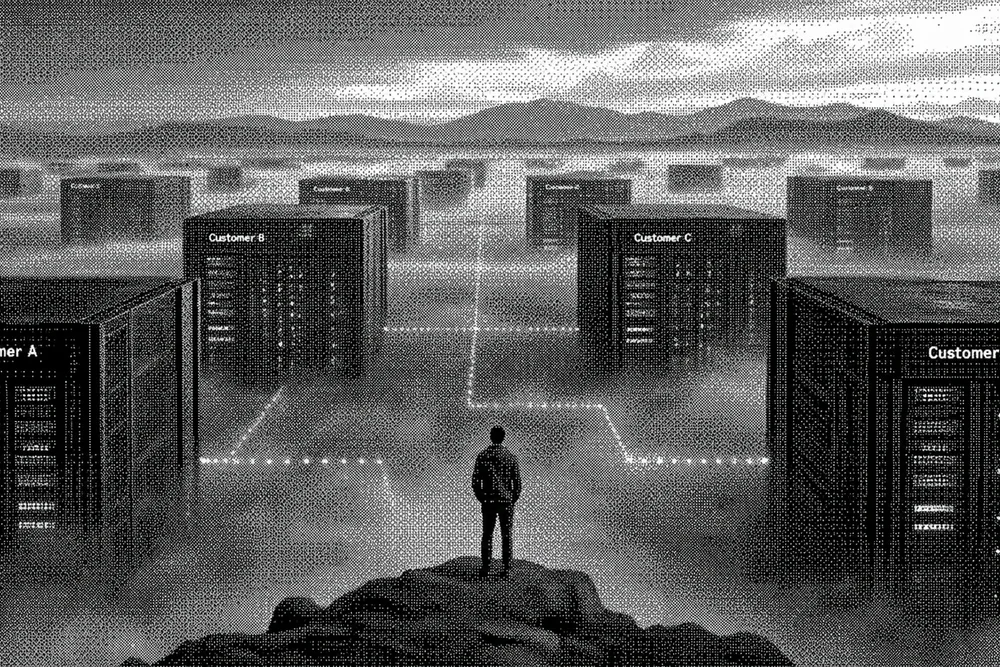
We take the view that the strongest way to protect a firm's data is not to build a better wall but to remove the shared room that made a wall necessary in the first place. This is what SCCR does. Because every client occupies a private codebase and shares it with no one, there is no adjacent firm's data for yours to leak into, and no adjacent firm's agents that could ever reach it. Because entry to that codebase is granted rather than assumed, no one holds standing keys to it, and that includes Vantage. The protection does not rest on a promise that the wall will hold. It rests on the plain fact that there is no shared room to break into.
The wall is not the guarantee
It is worth being fair to the conventional approach, because multi-tenant security is real engineering and is frequently done well. Serious vendors invest heavily in the permissions systems that keep one client's data from surfacing in another's session, layer defense upon defense, and submit the result to external audit. None of that is theater. The difficulty is more fundamental than the quality of any given implementation, and it is this: all of that effort is defense laid over a shared substrate. Your data was commingled with everyone else's by default, and then separated again by code. The isolation is therefore a property the vendor continuously maintains, rather than a property of where your information actually lives, and a maintained property is only ever as reliable as its next configuration change.
Beneath that sits a second assumption most buyers never examine, which is that the vendor's own staff can reach your data when they judge it necessary. Support, debugging, and day-to-day operation all require it, and so it is granted, and so it is normal. For most software it is an acceptable trade. For institutional capital it is the wrong set of assumptions to inherit without question, because this is the population whose information is the most sensitive it exists to protect, and for whom the consequences of a single leak are the most severe. A trust model designed for the median software buyer is not the trust model this work deserves.
Two guarantees that only isolation can give
No cross-firm leakage, because there is no cross-firm. The most consequential category of failure in a shared platform is the one in which a boundary error makes one client's information visible to another, whether through a flawed query, a mislabeled record, or an agent operating across a shared index. In SCCR this entire class of failure is not mitigated or reduced. It is absent. You are the only firm on your codebase, which means there is no second firm whose request could ever return your records, no second firm's agent running in the same environment as yours, and no shared index in which a single mistake could expose one client to another. The risk was not defended against. It was designed out of existence.
Least privilege that extends all the way up to us. The second guarantee concerns who may enter your environment at all, and the answer is that the list is short and it belongs to you. The only standing users of your platform are the people you have invited. When a piece of work calls for a Vantage operator, whether an analyst, an investor-relations specialist, or a back-office professional, that person is admitted to your environment for a defined engagement, granted access to exactly the information the engagement requires, and walled off from everything it does not. Access is scoped to need, and it expires. No Vantage employee holds unfettered or standing access to your platform, because the architecture makes no provision for it. The people who work alongside your team are given the keys to a room, for a reason and for a time, and never the keys to the building.
Isolation of this kind normally carries a penalty, which is that an isolated instance tends to fall behind while the shared platform moves on. That penalty is the one we removed in the previous essay in this series. A fleet of integration agents keeps every private codebase current, propagating each improvement and every security fix across the whole set without anyone reconciling them by hand. The result is the arrangement that was supposed to be impossible: the isolation of a single-tenant system with the freshness of a shared one, and neither purchased at the expense of the other.
Security you cannot retrofit
There is an admission inside this architecture that is expensive enough to be worth stating plainly. We did not begin with SCCR. We started building Vantage much the way most platforms are built, and some distance into that work we came to understand that the guarantees described above could not be added to a system that had not been designed for them from the outset. Isolation that is bolted on afterward has a seam, and a seam is exactly what a determined adversary, or an unlucky configuration, eventually finds. A security property that some part of the system predates is not a property at all. It is a hope holding good intentions.
So we asked ourselves a costly question. What would this platform look like if the very first line of its code had been written with this objective in mind? Having answered it honestly, we rebuilt the engine from that first line. The entire Vantage codebase was reconstructed to be SCCR-native, so that the isolation and access model is not a layer resting on top of the platform but the assumption the platform is made out of. It was not a cheap decision and we did not reach it lightly. We reached it because the firms we set out to serve were always going to demand a standard of data protection that no retrofit could honestly meet, and we would rather pay that cost once, at the foundation, than spend the life of the platform explaining why it was missing.
A security property that some part of the system predates is not a property. It is a hope. The only way to guarantee it is to make it the first assumption, not the last feature.
The same allocation, applied to your data
This connects to everything else we have written, because the security model is the same allocation we describe throughout, now turned on the data itself. The agents perform the categorical heavy lifting, keeping every isolated codebase synchronized and current across the entire fleet, tireless work no team could sustain by hand. The humans hold the decisions where accountability cannot be delegated, which here are the decisions about access: who is admitted to your environment, what they are permitted to see, and when that permission ends. Those are not settings a system should be allowed to grant itself, and in our design it cannot. The machines take the coverage, the people keep the judgment, and the principle reaches all the way down to the question of who may stand in the room with your data.
The most secure system is not the one that accumulates the most controls. It is the one in which the worst outcome simply cannot occur, because the conditions that would produce it were never built. You are the only firm in your room. No one holds standing keys to it, ourselves included. And that has been true since the first line of code, because we decided it had to be, and were willing to rebuild everything in order to make it so.
Vantage protects your data by architecture rather than by promise: your own codebase, no standing access for anyone, and cross-firm leakage designed out of existence.
Conviction Made Citable.